
What to look for? Proportions? Where to change?
I shall next only scratch the surface attempting to answer these questions altogether.

We are in the very end building a soundbox, a box that produces sounds (isn’t that obvious?). What can possibly influence this?
Differentiating violins altogether
How? There are three areas that distinguish violin makers (most of the time, all other things being equal):
- The scroll.
- The C-bouts shape.
- The ff-holes shape.
Makers would add some personality on those items. They could also create a distinct bee-sting, employ exotic wood on linings, or even use corner blocks in a different way, however, those are quite cosmetic (and sometimes hidden, like the latter).
Tradition and “evolution”
The violin form that we are used to nowadays is an “evolution” of different instruments over time.
Notable examples are the Rebec and the Viola da Gamba, as seen in the next figure alongside other examples.

Proportions
Size matters. 😀
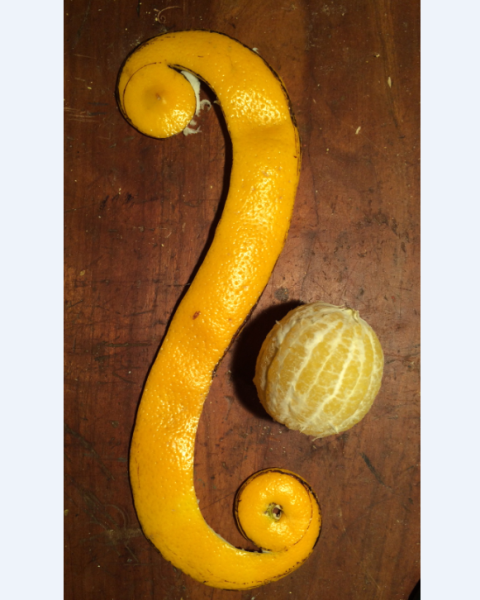
The scroll in particular could employ the “Golden Ratio”, or a Fibonacci spiral.
In this link, one could fine a very good explanation of the Fibonacci Sequence:
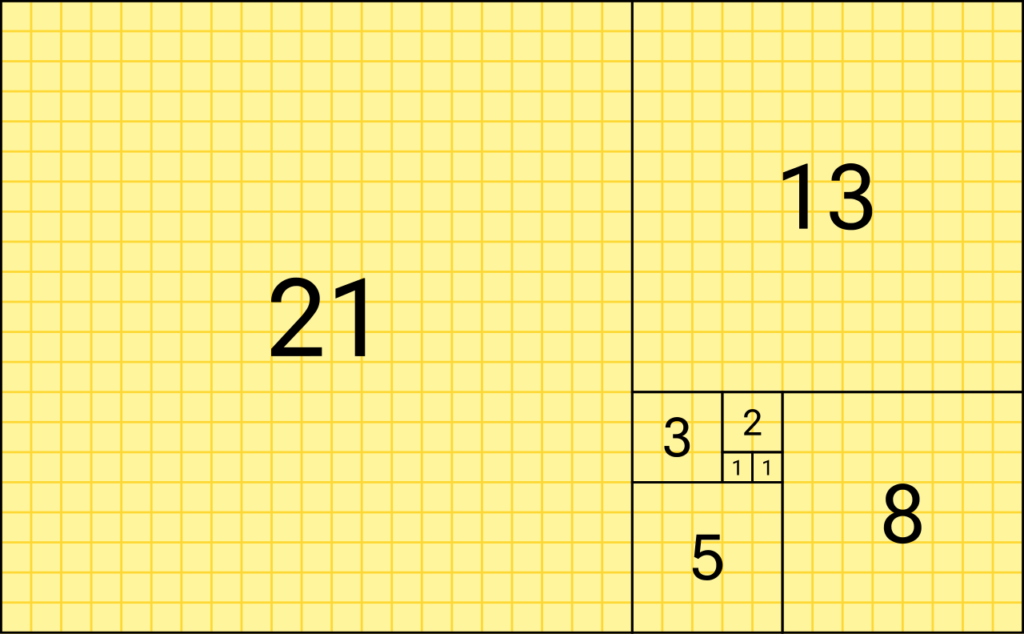
It’s basically starting with 0 and 1 and counting the last two numbers (starting points are [1] and [2]):
- [1] 0
- [2] 1
- [3] 1+0=1
- [4] 1+1=2
- [5] 2+1=3
- [6] 3+2=5
- [7] 5+3=8
- [8] 8+5=13
- [9] 13+8=21
- …
We generated the first 9 numbers of the infinite series.
They used to think this represents rabbits’ population growth, but it has been refuted through experimentation.
It’s more interesting to think that those patterns are present in Nature, such as branching in trees, leaves in stems, fruit sprouts in pineapple, and so on.
And then we get to talk about the Golden Spiral.
One way to create a Golden spiral, approximating a Fibonacci spiral is as follows.
- Create a triangle rectangle with double the sides, ie, if one side has 3 units of length, the other will have 9 units (and vice-versa).
- For this case, you’ll see the hypotenuse has size 6 (using Pythagoras’ method).
- Use a geometry compass to find the length of the next segment.
- Draw a semi-circle with that length.
- Find out where it hits the hypotenuse. This is your next segment.
- Keep drawing semi-circles as you wish, repeating steps 2-4.
- Profit.
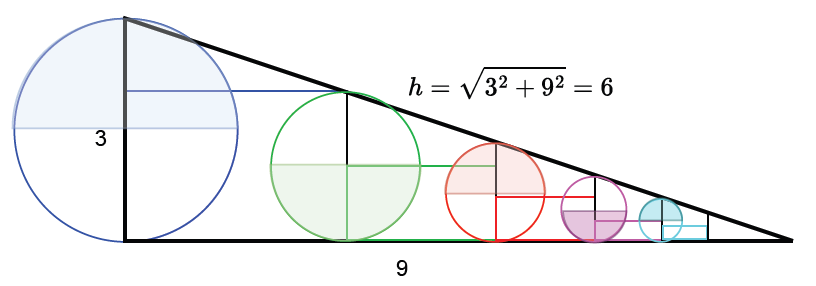
Then:
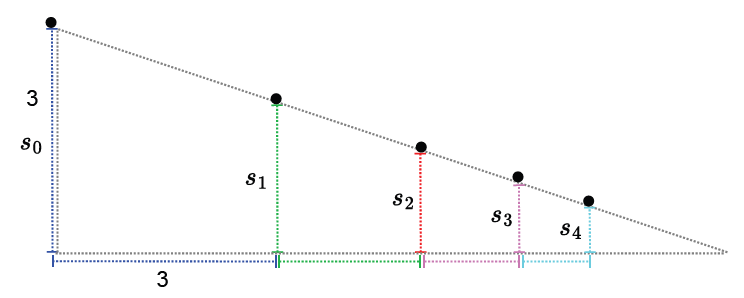
Finally:
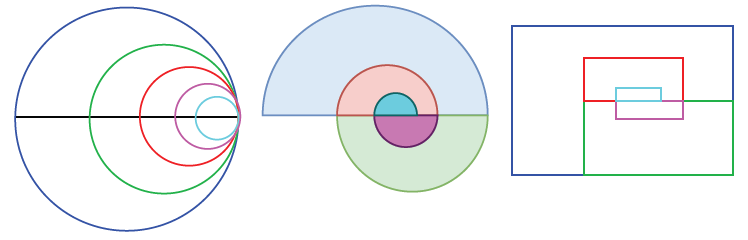
So, technically speaking, you can change this at will, and if you wish to keep it looking like a Golden spiral, just follow those ‘rules’ and you will be fine.
Curtate cycloids
According to Mathworld Wolfram’s website:
A curtate cycloid, sometimes also called a contracted cycloid, is the path traced out by a fixed point at a radius b<a, where a is the radius of a rolling circle.
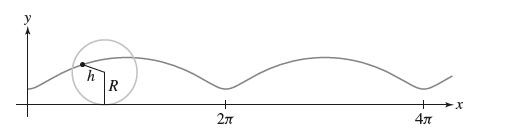
By varying h one can generate other segments.
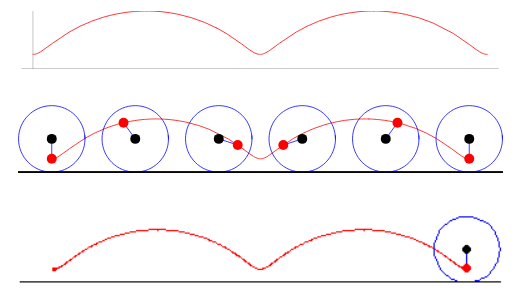
Making the violin’s website discusses curtate cycloids in Arching section, with good examples and figures.
There is this tool by Professor Stephen Mann for representing cycloid curves. You can play with different parameters and even generate PDFs.

There’s a (fruitful?) discussion in Maestronet about this topic (one out of many).
Choice of wood
Wood has a distinctive influence on sound.
Basic wood are:
- Maple for the back and the bridge.
- Spruce for the top.
- Spruce or willow (or other) for corner blocks and linings.
- Ebony for fingerboard, pegs, end-button, and tailpiece.
One could search for alternatives, however, of course they come with lots of trade-offs. For instance, one could use pine (oh, the horror), however, the number of knots might be an issue.
Ebony takes a long time to grow and mature, thus they have secured protection so they don’t disappear from the face of the Earth.
A replacement for ebony is tamarind or rosewood (this one also protected – link for Brazilian Rosewood as there are many species). Osage Orange has also been used.
Look also at sonowood.
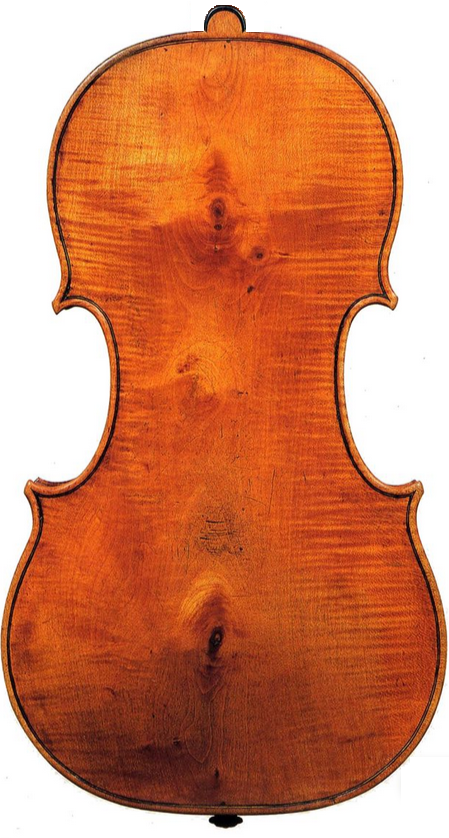
Knots in wood
Knots in violins have been used in the past and there’s an interesting discussion about this in Maestronet.
Observe the knots in the back of the 1670 ‘Tullaye’ – it makes one wonder whether or not Stradivari had limited access to wood.
Linseed Oil and Boiled Linseed Oil (BLO)
What about submerging wood in linseed oil: would that change anything?
It penetrates wood quite deeply, and it might affect sound.
Linseed Oil never really hardens whereas Boiled Linseed Oil (BLO) hardens more quickly.
First of all, safety alert: rags soaked with BLO might spontaneously combust. This is a known issue in woodworking (YT Video).
Theoretically, you could immerse wood on BLO, however, I can’t get on this rabbit hole right now.
FF-holes
As we know, ff-holes directly influences the sound.
There were people looking at other things to create these holes, like this Strad Magazine’s article:
Body
One could “play” with different radiuses in curtate cycloids and come up with a different body structure.
Varnish
Both internal and external varnishing could affect sound. Use of oil x spirit varnishes also.
And, lest not forget, employing magickal components and wizardry might come in handy as well.
Adding varnishes and other components to violin might be the holy grail of violin making, a secret that nobody really knows for sure (“What do we really know?” – Sam Zygmuntwicz).
I can’t get into this in this post, but certainly, it’ll be the subject of my forthcoming studies, for sure.
Soundbar and soundpost
You could design your own soundbar.
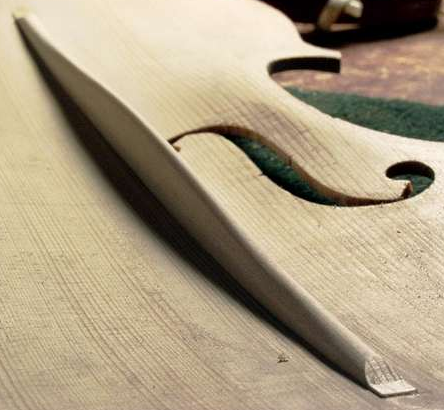
For soundposts, I wonder: could one vary it for improvements? I reckon not but well, everything is possible, right?.
Corners
Could violin corners have an influence in the sound?
Most likely not.
I have posted an interesting discussion about this earlier.
Bridge design
Bridge is important in violin construction. I have discussed this in a previous post.
Adaptation to varied humidity levels
We all know the influence of humidity in wood and how the violin withstands it over time, not presenting cracks or major issues related to wood contracting and expanding.
Zero influence on sound
These will never influence produced sound.
- Scroll
- Pegbox
- Bee sting
Epilogue
This has been yet another wild ride. I thank you for reaching out till the end.
Obvious things that still affects sound after construction:
- Player’s ability.
- String quality.
- Bow quality.
- Violin’s age and conservation.
- Human biases towards violins.