
There’s the classic bridge design (in blank state), that they say it was conceived by Stradivari, that follows the following pattern:

Despiau is a very good brand worldly recognised for their high quality wood manufacturing. More information (for purchasing) in this link with explanations on wood selection and quality grading. Mr. Nicolas DESPIAU (CEO of Despiau Chevalets) comments that “remember, at least 20% of your instrument sound is delivered by your bridge”. Here’s what they say about their “Chevalet Despiau Supérieur”:

And this is how you can see what you’ve bought:

Bridges are usually made out of maple, but one could use other types of materials like sycamore, ebony, and even spruce (with a different design). There’s this interesting post on Maestronet discussing exactly this.
In terms of grain orientation of bridge blanks, it follows this:

The bridge plays a vital part (no pun intended 🙂 ) on violin making, responsible for the final sound produced by the instruments, as I’ve discussed earlier on the cross-section of a violin post.
It can attach a metal, rubber, leather, or wooden device called a mute, or sordino, to the bridge of the violin gives a softer, more mellow tone, with fewer audible overtones:

Maestronet has an interesting post on “Cutting your own bridge blanks”.
Each part in a bridge has a designated name:

Violin makers could enlarge the kidney ellipsis, smooth some areas they believe it’s worthwhile (for improved sound), and fitting the arch to the belly, positioning it near the soundpost and the bassbar for ‘optimal’ results.
User Don Noon (Maestronet) shared his bridge design, which consisted of a modified waist (notice also how he changed the wood on the point where the string touches the wood):

He experimented with high frequencies responses in a piece of rosewood.
There are some vendors that sell maple bridges with ebony inserts (instead of letting players use a bridge parchment):

As I’ve discussed in previous post about violin parts names, a luthier must take a bridge blank and use bridge templates to account for string thickness:

This is the template commonly employed to help in this task:

Designs
This next design was allegedly made by Vuillaume:

Notice that the base looks like it was modified (in height) and also the notion that the the curvature followed more or less the blank only that the cavity is downwards more. This could be a fake.
Bridge designs
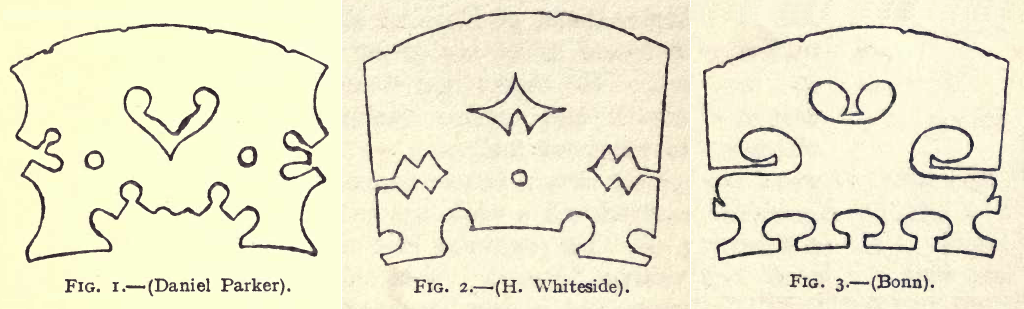
Bridge design can change, for instance, look at these ideas:

And this model here:

And look at this heart-shaped model by Despiau (three trees, ie, top quality):

Contemporary looks
And this one with a more modern look:

And here’s another contemporary design worth noticing:

Finally, I’ve bumped in these ones in the internets:


Instagram bridge designs

And:

By Anders Norudde:


Other interesting things
I’ve seen a post discussing a viola with “four playing and eight sympathetic strings running beneath the fingerboard” that I felt I should share here:

The bridge has a cool modified design and 8 holes underneath the other strings.
The f-hole has also a different design (a.k.a., the “flaming sword of Islam”). A neat design altogether.
Epilogue
This doesn’t end this discussion, obviously, as it’s my intention to keep documenting new designs as I find them in the future.