I caught the bug of creating templates (perhaps what others describe as “fiddle disease”? I cannot speculate about that), well, at least these past weeks.
Looking at the remarkable video by Jon Mangum (How to Build a Fiddle — Part 9: Finishing the Scroll and Neck), on the 00:14:35 mark, he details how to create your very own neck template.
And that’s what we’ll build today.
For this, you’ll require:
- a template: I’ll use my 1741 Kochanski neck template (that I acquired at Dictum);
- a piece of paper;
- a compass;
- a ruler, or caliper.
Not the following measurements are only provisional, as they don’t account for the actual size of the neck. Here’s my template measured:

Note that it measures about 134mm, accounting its curvature:

There’s no need to create this template with that size, because you already have the neck template to help you with the actual size.
So, let’s start by creating this base template:

Now, using your template, mark the outline on each end, a bit (1mm) shy to the inside of that 100mm area, as shown next:

Put your own style when extending those lines, remember, it’s your violin/fiddle and that shape will not translate to any gains in sound, as it’s far away from the soundbox itself.
Now let’s work on the neck shape itself, on the start and on the end, we’ll mark to semi-circles of radius 15.5mm and 13mm distant respectively 25mm and 70mm from the leftmost point.
You’ll have something like this:

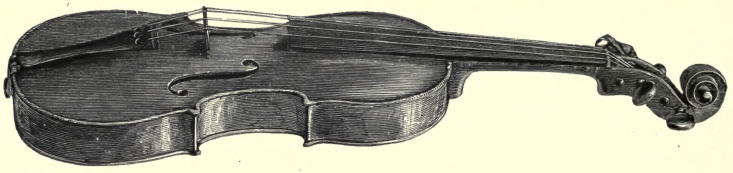
We understand a further understanding on the nomenclature of the neck’s parts, look at this image excerpt extracted out of Making the Violin’s website on Measurements1:

There’s interesting names in there: the duck tail (or hen’s tail), the nape (or curb), and the heel. So, this next should be the final neck template shape:

And voilá, there’s your very own neck template. This is but a guide to help you carve out the neck. It should be 13mm thick on the heel’s side and 12mm thick on the duck tail’s side.
Now you can check whether your neck has a flat bottom, you can check the curb and you can check the heel curve as well.

This is what you shall do:

And, please, note that this is not to scale, ie, you cannot simply print this and hope it’ll match your design. You should create this template from scratch, as outlined here.
Well, aamof, if you’ve bought an expensive violin, that’s one very cheap way of checking the violin maker’s abilities on the neck.
You can use any material to create this, cardboard, wood, acrylic, or metal, you name it. I’ve made out of of some scrap oak I had:

I wish you the very best of luck!
Footnotes:
- Based on Antonio Stradivari’s ‘Messiah’ 1716 violin. ↩︎