
Yes. We are in the end building a soundbox or acoustic box that will create music when musicians produce the right vibrations on strings.
Here’s a cross section of the centre of a violin with a fitted bridge:

The strings are tuned to GDAE, ie, Sol, Ré, Lá, Mi pattern:

All the constituent parts of a violin contribute to the sound. Read all about Helmholtz resonance in Wikipedia.
The bridge exerts a “rocking motion” as shown by the next figure:

Given that the G string is the widest, it makes extra rocking movement on the bridge.
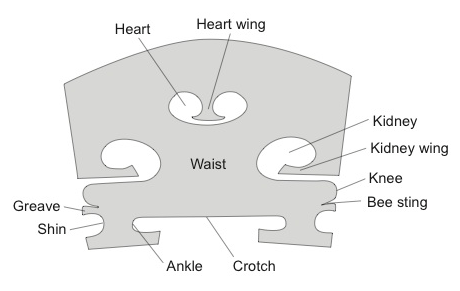
Violin bridges are normally bought as a blank or unfitted, and then luthiers use a specialised tool to fit it, accounting for string’s gauge (or thickness) – note that the figure’s order is inverted, EADG instead of GDAE:

This next is what is done in this phase, from a bridge blank to a final fitted bridge:

Because the E string is so thin, it could damage the bridge. For this reason, luthiers add a “bridge parchment” (or bridge protector) to prevent damage.

Some vendors even sell “titanium bridge clips” on-line, but perhaps it’s ‘too much’, innit?

Some bridge measurements for a 4/4 violin:

The bridge overall thicknesses are (according to “making the violin”):

You could also purchase a “bridge string lifter” to work on the bridge without having to loosen the strings:
Older model by Réné Morel:

Another model (modern):

Well, this finishes the idea of creating soundboxes.
Epilogue
I was reading about “violin forensics”, and there’s this amazing website (research project with University of Vienna) that does remarkable work on the subject, showing CT scans of violins in an attempt to reveal the secrets of the masters.