
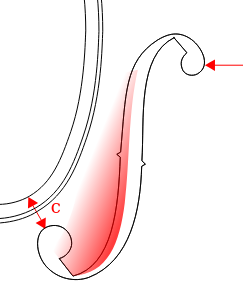
When it comes to make the ff-hole fluting1, this is the region where wood gets removed (out of Making the Violin manual), ie, in violin making jargon, the lower wing of the ff-hole gets scooped out:
Does it improve the sound? No. (however, do see Sam Z.’s video by the end of this post…).
Does it make any improvements at all? Only to the design and beauty of the piece, ie, it’s purely aesthetic.
OF COURSE there are discussions about this at Maestronet.
When to do it? One can do the ff-hole fluting before cutting the ff-holes or after. Look at this example where the fluting was done before (by Derek Roberts violins):
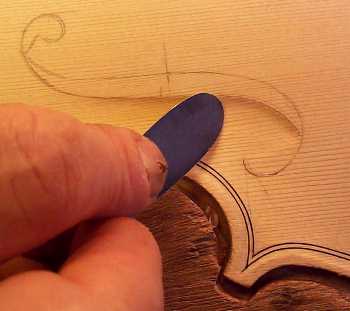
Some fluting are quite shy whereas others are quite pronounced.
(I’m inventing new violin making lingo as I go, great. It’ll never be used by anyone else – gladly so – nevertheless, I’m doing it).
Examples
Look at the first example:
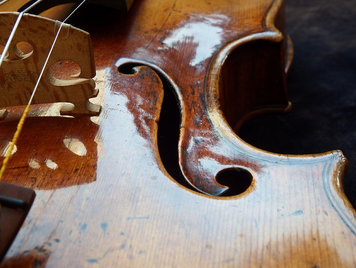
How slick2 is that?
Look at another example:

That Maestronet article mentions this ff-hole fluting style as made by Aristide Cavalli (Cremona, 1932), however, I have found no further evidence to substantiate it:

It looks, hmm, good? Extravagant? Vanguardish? Weird? I’ll let you decide.
See this video by Strad3D project when discussing ff-hole designs (this is a must see video!).
Footnotes:
- There is also fluting on the purfling, and on the scroll, and so on, so ff-hole fluting is used for differentiation. ↩︎
- Slick (UK): done or made in a way that is clever and efficient but often does not seem to be sincere or lacks important ideas. ↩︎