
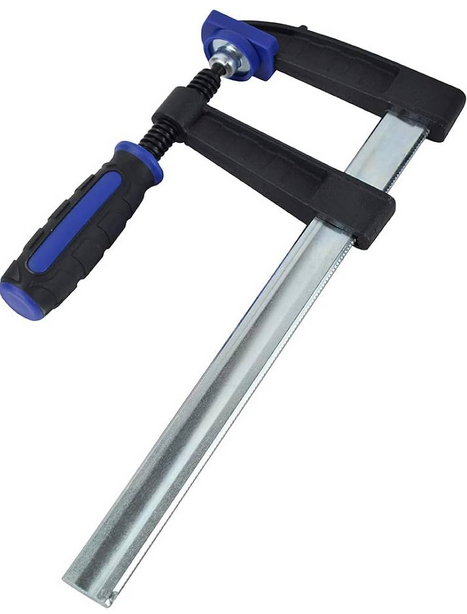
Let’s talk about clamping (cramping?).
On several occasions throughout violin making or general woodworking, you will need to clamp wood together to settle the glue and fix parts or laminate pieces.
There are specialised clamps that you might think for violin making, as shown as follows.
When one starts ‘collecting’ clamps, one never stops. You’ll always need another 12-set for some work.
Spool clamps
Here is an interesting video on YouTube on how to build these clamps. It’s used to withhold the top and bottom plates of the violin in place (and wherever else you like to use it). For a standard 4/4 violin, someone counted 28 (it’ll depend on the radius of your clamps).

There’s also this model:

Garland clamp

Bassbar clamps
Piotr Pielaszek has demonstrated his approach to clamp his bassbar that is quite neat, requiring two ‘normal’ clamps and auxiliary ones with minimal force.

You could modify your existing F-Clamp to extend its mouth:

Reinforced rubber-band clothes-pin clamps

They are also called “lining clamps”. Or maybe this alternative:

These clamps are useful for gluing the sidestrips into the garland. They are very cheap to make and very useful.
I usually cut the ends out so my significant other (SO) don’t “have ideas” on borrowing it.
You could also use these options:


Lap or lapstrake clamp

Or this one:

This next one uses a string to add strength to the pulling:

Cam clamp

These clamps could be used for gluing the bassbar, and they could be built using only wood for all parts. It’s a nice project to delve into.
Violin bridge cradle clamp
Here’s the discussion on Maestronet. The idea is to press the bridge to set depth.

Glueing clamps or repair clamps
These are long (mouth) clamps usually employed for holding the bassbar in position.

And used profusely:

Generic clamping
You can use F-Clamps, G-Clamps, Fast (or quick ) clamps, sash clamps.
F-Clamp (used in several tasks, pay attention to the mouth length):

G-Clamp (sturdy clamps, stronger than f-clamps)

Sash clamp (this could be used to laminate plates)

Fast clamp (advantage of this type is that you can clamp with one hand)

Ring clamp

The idea here is that the piece of wood, when inserted into the end of the clamp, helps increasing or decreasing the grip on the piece. The disadvantage is that the ring determines how wide the mouth opens.
Tower Block Clamps
This is used to glue/re-glue tops or bottoms:
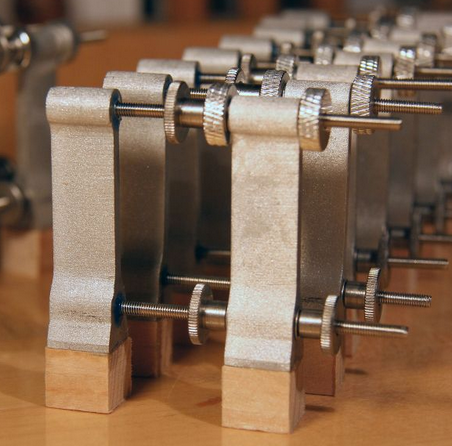
One example of use as follows:

The parts have simply disconnected, now one should re-glue it and use those tower clamps to put them together again.
Cradles


And the simplest possible way of working the tops:

That one is quite simple and ‘does the job’.
Epilogue
I won’t cover here repair clamps, neck settle clamps, etc., because one could go through this rabbit hole quite further.