As Jon Mangum put it, in his “How to Build a Fiddle” series on YouTube (which I strongly recommend you to see, a 14-part series), a violin follows traditional materials, mostly spruce for the top, soundbar, and soundpost, maple for the back, neck, bridge, and sides, and ebony for the fingerboard, tuning pegs, saddle, and end button. Some violin makers would use willow for the sidestrips, although I’m not sure any ‘religious rules’ or dogmas I would be breaking.
On the other hand, a fiddle has no such constraints, as any wood could be used in the construction. So, oak is allowed, cherry, even knotty pine!
On the book “British Violin Makers” (MCMXX, ie, 1920) by Rev. W. Meredith Morris (B.A.), second edition, on page 315 (Appendix G), there’s a very good explanation and differentiation of fiddle/violin that’s worth consulting1.
As I’ve mentioned before, some classify and differentiate fiddle and violins from the type of music that it is played, but here, now, I won’t go any deeper in this rabbit hole.
Basic principles for working with wood
Wood is a live material. Even after it’s felled it remains ‘working’ and twisting. You cannot forget about this whenever you are working with wood as failing to acknowledge this could cause your work to break, split, or even collapse altogether.
Because it is ‘moving’ depending on humidity and other conditions (where you place, temperature, etc), good wood handicraftsmen must account for wood movement. That’s why we see doors with panels, some joints are ‘missing’ parts, ie, they all accommodate the fact that wood will invariably move over time.

Wood is indeed a live ‘beast’ with particular taxonomy for its constituent parts.
We now differentiate common wood out of tonewood.
For the beginner amateurs at this point is sufficient to know that common wood has a lot of knots and odd bendings (due to storage or other ‘forces’) and that tonewood has almost no knots and characteristics suitable for making wooden musical instruments.
David Folland has a good article on this. The idea is to work with either a slab or a wedge of quarter-sawn wood. There are differences on this choice, and discussions on the join strength to account for wood movement over time when pieces are laminated as the wood direction counterbalances this effect.

The image shows a section (or wedge) of quarter-sawn wood.
To understand the different types of wood cuts, observe the following image:

Violin makers use a piece of quarter-sawn wood (split in two and then laminated) for making instruments.

A wedge of wood is split and then laminated.
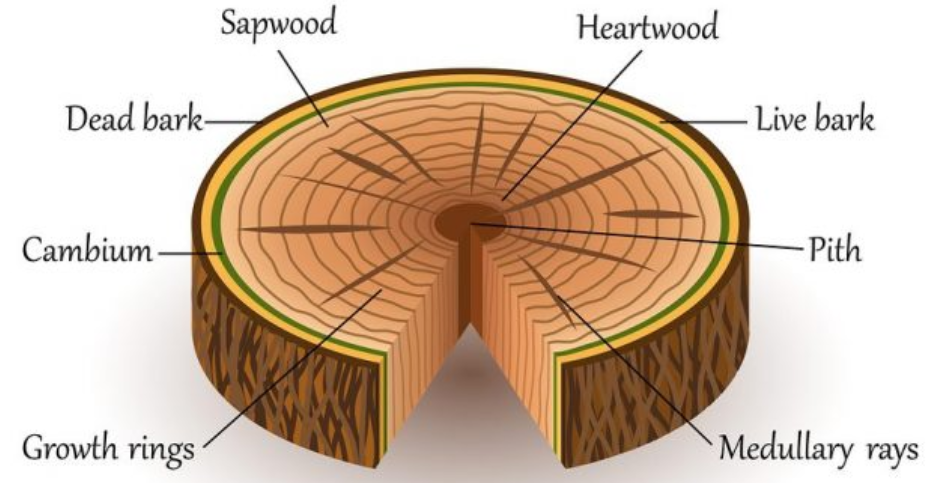
Dendrochronology tells us how trees grow, ie, inner rings are older than outer rings:

So, younger wood is located on the outwards parts of trees, whereas older wood is located in the inwards sections.
NIST/US has a good informative guide on How Do You Measure the Age of a Tree.
Finally, the violin/fiddle has this format:

A quarter-sawn piece, laminated and final shape, showing new wood (on the centre) and old wood (on the sides).
Here’s another view of the violin marked out in two wedges:

As we can see, well-made violins do stand the test of time, as we see nowadays specimens built in the 17th century.
Buying tonewood on-line
Well, there’s many tonewood suppliers in the market. In the UK I have used the services of David Dyke (Luthier Supplies) for purchasing wood. In the UK, there’s also Touchstone Tonewoods, Keystone Tonewoods. I haven’t used these last ones (as of Oct/2023).
Maestronet’s Forum has some discussion on this topic, however, it’s quite outdated (2015).
Let’s quote materials now. Suppose you make up a list comprised of:
- Spruce Top – Split = £37
- Maple Back & Ribs = £29
- Spruce for Corner Blocks = £7
- Unshaped Fingerboard (AA) = £12.50
- Spruce Bass Bars (Split) = £3
- Soundposts – 200mm long (AAA) = £5.25
- Neck Block (A) = £11.50
The quality of wood (A, AA, AAA) by this particular vendor, shifts the prices accordingly. For this selection, I chose some middle-quality materials.
I haven’t tested it, but I believe one can make the strips out of the “Spruce for Corner Blocks” given the volume of wood that comes in that item.
This yields about £106 (+20% VAT) + shipping (£10 in the UK) on 13/09/2023 (total=£138).
Epilogue
This is by far not a cheap hobby if you would ask me.
Footnotes:
- Verbatim reproduction of “British Violin Makers” (1909), Appendix G: ON THE USE OF THE NAMES “FIDDLE” AND “VIOLIN”.
Within recent years the word fiddle has fallen almost completely out of use in polite speech, and writers also show a tendency to discard it. Some people use the word to designate instruments of an inferior class, reserving the word violin for those of the better sort, or for classical instruments. Fiddler and violinist are treated in the same way, except that the former appears to have even a greater stigma attached to it than has the word fiddle. There is a fashion in the use of words even as there is in ladies’ hats, but in the case of the names under discussion it signifies nothing really to the historian and etymologist, for both words mean precisely the same thing. In all probability they come from the same root.
Fiddle is the modern form of the O.E. fidele and fithele ; A.S. fiftele, and sometimes viftele. The word is akin to the Danish vedel, O.H.G. fiedel, M.G. fiedel, and Icel. fiftdla. All these forms appear to be ultimately connected with the late Latin vitula, which is of uncertain origin, but which in all probability comes from the early Latin vitulari, to celebrate a festival, originally to sacrifice a calf. [Vitulus a bullcalf ; vitula a cow-calf]. Vitula was the goddess among the Romans who presided over festivals and rejoicings.
Violin (with all its Romance equivalents) is the Italian diminutive of viola, derived from viol, which (according to the accepted etymology) is also derived from vitula, just like fiddle. Veal [O.E. veel, O.F. veel, M.F. veaii] and vellum, vituline, are, of course, cognate words.
The disappearance of t in viol (viola and viula] is in accordance with one of the sound-laws which govern the passage of popular spoken Latin into the Romance dialects, whereby a medial consonant between two vowels is generally syncopated, as, e.g., magistrum in modern French becomes maitre ; securum = sur ; rotundum = rond, etc. If the above be the correct etymology of the words fiddle and violin (and the weight of scholarship is in its favour), it seems a hard fate which has overtaken the former name.
There is no reason why fiddle should fall into disfavour.
Let us hope that another generation will have a truer appreciation of history and a keener sense of the fitness of things. The poor word crowd has had to go by the board long ago, but it was quite a respectable word, being related to the Gaelic cruit and the Welsh crwth.
It is remarkable how, in the growth of language, names and words which once were considered fitting and polite have come to indicate something which is offensive ; take e.g., the words gossip, vulgar, clown, pagan, silly, etc. If to the list of degraded words must eventually be added the word fiddle, that will be when ignorance is allowed to sit in judgment at the gates of elegance. ↩︎